

I hope you enjoy reading this blog post. If you want to book a free consultation, click here.
NEW DELHI — What happens when India’s green fuel transition collides with a customer’s broken-down dream car? You get a high-stakes legal battlefield that could rewrite the rules of automaker liability in the era of ethanol blending.
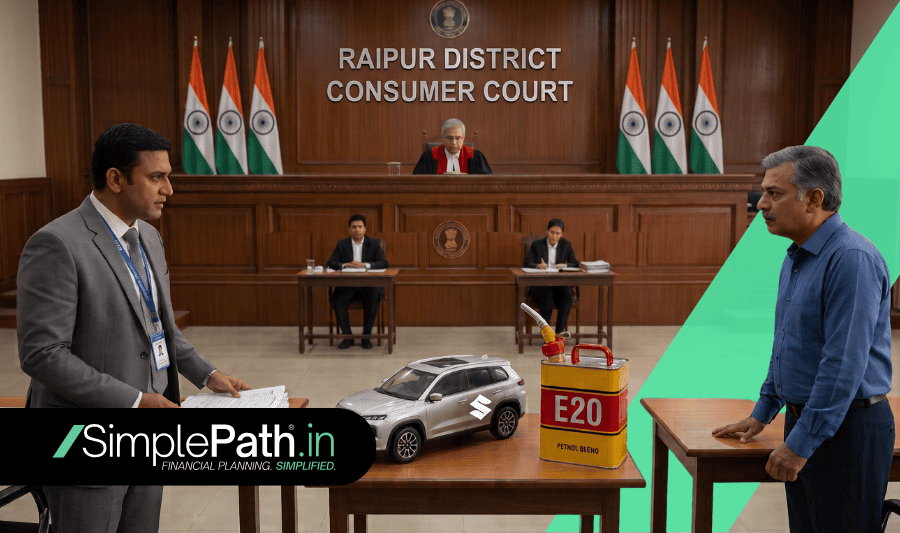
In a historic first for the Indian automotive industry, Maruti Suzuki India has officially announced it will challenge a consumer court order directing the carmaker to completely replace or fully refund a customer’s vehicle. The SUV allegedly suffered severe engine damage after running on E20 petrol—a blend of 20% ethanol and 80% gasoline.
The case marks India’s very first legal ruling connecting the E20 fuel transition to severe vehicle breakdown. It has sent shockwaves through the auto industry and left lakhs of new car buyers questioning who is responsible when eco-friendly fuel leads to mechanical failure.
The Nightmare Journey of Dr. Devta’s SUV
The consumer at the center of this legal storm is Dr. Premraj Devta, a 41-year-old kidney specialist based in Raipur. In June 2024, Dr. Devta purchased what he believed was a brand-new Maruti Suzuki Grand Vitara Strong Hybrid Zeta Plus for ₹18.29 lakh, assuming the hybrid technology would optimize his daily city commute.
However, the dream quickly soured. The timeline of the dispute reveals a deeply frustrating cycle for the vehicle owner:
-
The Age Trap: While sold as a new vehicle in mid-2024, court documents later exposed that the car was actually manufactured in January 2023—making it roughly 17 months old before it ever left the showroom. Dr. Devta alleged he was never informed that this specific batch lacked full compliance with the country’s accelerating E20 transition.
-
The “Curd” in the Tank: After running smoothly for 21,913 kilometers, the Grand Vitara flagged an engine malfunction in November 2024. The SUV proceeded to stall mid-road five to six times. During repeated visits to the workshop, fuel drained from the vehicle showed an alarming physical degradation—turning from clear to white, until a thick, “curd-like substance” began separating and pooling at the bottom of the tank.
-
The Deadlock: By March 2025, the vehicle was completely undriveable and left abandoned at the dealership. According to Dr. Devta, the company demanded a staggering ₹5.30 lakh out-of-pocket to replace the entire engine assembly, refusing to cover the cost under the standard mechanical warranty.
Why the Insurance Company Wasn’t the Answer
Under typical circumstances, a vehicle owner might turn to their comprehensive car insurance policy to offset catastrophic repair costs. However, Indian auto insurers almost universally reject claims involving fuel compatibility or engine damage stemming from adulterated fuel, classifying them as mechanical failures rather than accidental damage. Left with no insurance safety net, the consumer took the ultimate step: suing the country’s largest carmaker for selling a faulty vehicle and practicing unfair trade.
The Court Rules: Unwinding the Entire Sale
The Additional Bench of the Raipur District Consumer Disputes Redressal Commission, led by President Prashant Kundu and Member Dr. Anand Varghese, sided decisively with the buyer. The commission held both Maruti Suzuki and its local dealer, Nexa Magneto (Sky Automobiles), guilty of “deficiency in service” and “unfair trade practices”.
The court ordered Maruti Suzuki to provide an exact financial refund totaling ₹20,50,494, meticulously broken down to shield the consumer from any out-of-pocket losses:
| Refund Component | Amount (INR) |
| Original Vehicle Cost | ₹18,29,000 |
| RTO Registration Charges | ₹1,86,000 |
| Car Insurance Premium Reimbursement | ₹34,644 |
| Compensation for Mental Agony | ₹1,00,000 |
| Litigation Expenses | ₹10,000 |
| TOTAL COURT-ORDERED PAYOUT | ₹21,60,494 |
The court stipulated that if Maruti Suzuki fails to replace the vehicle or issue the full refund within 45 days, the total amount will attract a 7% annual interest rate until fully settled.
Maruti Suzuki Striking Back: “The Fuel Was Contaminated”
Maruti Suzuki is not taking the ruling lying down, confirming it will appeal the decision at a higher judicial forum. The automotive giant has forcefully pushed back against the narrative that its engineering failed.
“The car in this case was an E20 compatible car, fully equipped to handle E20 fuel and so disclosed in the owner’s manual,” Maruti Suzuki stated in an official press release. “There is evidence of contamination in the fuel collected from the customer’s vehicle. Several other relevant facts have also not been reflected in the order.”
The carmaker’s entire defense hinges on laboratory test reports of the fuel sample taken from Dr. Devta’s SUV, which reportedly proved the fuel was heavily contaminated with external impurities—a variable outside any manufacturer’s control.
A High-Stakes Legal Precedent
The final outcome of this appeal will be monumental for India’s green goals. The Indian government has rapidly rolled out E20 fuel nationwide, with industry bodies repeatedly reassuring the public that the blend is entirely safe for modern vehicles, despite an expected 3% to 3.5% drop in overall fuel efficiency.
If the higher courts uphold the Raipur consumer forum’s original order, it could create a massive legal headache for carmakers. Legal experts warn it could open the floodgates for thousands of disgruntled motorists to drag manufacturers to consumer courts the moment their engines experience hiccups post-E20 transition. For now, the question remains: when a green car chokes on green fuel, who pays the ultimate price?
Share This Story, Choose Your Platform!
About the Author: Donald Gonsalves