

I hope you enjoy reading this blog post. If you want to book a free consultation, click here.
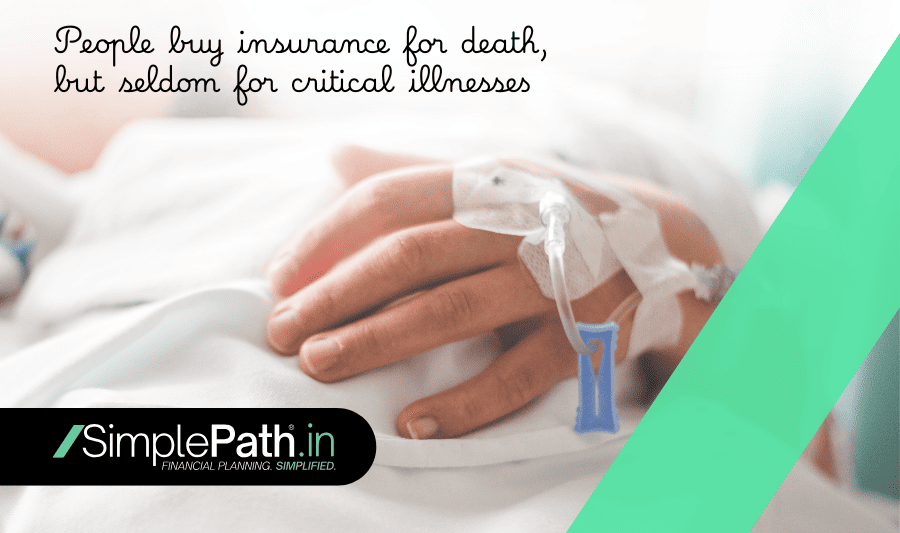
For years the concept of buying a term insurance has always been ‘financial protection against mortality.’ With the help of HLV (Human Life Value), a person is able to judge the best amount that he /she can get an insurance cover for predetermined number of years with a term insurance. The entire equation of term insurance changes when you anchor the term insurance policy around Critical Illness (CI) coverage. With this, what was once a passive protection against mortality becomes an active contract against morbidity. Critical Illness rider to a term insurance alters everything – from how you calculate coverage to how you choose policy term. It even alters how insurance companies underwrite your health and process your claims. While term insurance is the first step towards financial freedom, adding CI rider will simple reinforce that step.
Prioritising Morbidity Over Mortality with Critical Illness Rider
The traditional assumption that lifestyle and life-threatening diseases belong to the post-55 demographic is broken. The data from various reputed medical organisation suggest ‘Young India is getting sick.’
1. Heart Disease & Stroke Under Age 45
- 25% of all heart attacks in Indian men occur under the age of 40, and nearly 50% occur under the age of 50, according to data from the Indian Heart Association.
- Data from hospital registries across major metro cities in India indicates that acute coronary syndrome (ACS) cases in the 25–40 age bracket have doubled over the past decade, heavily driven by chronic work stress, sedentary routines, smoking and metabolic syndrome.
2. Cancer On A Rise in Young Working Adults
- The Indian Council of Medical Research (ICMR) and the National Cancer Registry Programme (NCRP) project India’s cancer burden to cross 15 lakh cases annually, with an aggressive upward shift in early-onset malignancies.
- Breast cancer accounts for 27.3% of all cancers in young Indian women aged 15 to 39.
- Oral and gastrointestinal cancers are now the leading cancer diagnoses among Indian men under 40.
3. The Pre-Disease Pipeline in the Urban Workforce
- The Apollo Health of the Nation Report revealed that 2 in every 3 young adults in India are already at significant risk for Non-Communicable Diseases (NCDs).
- Among working professionals with an average age of 38, nearly 50% present with prediabetes or diagnosed diabetes, 1 in 4 has hypertension, and 8 in 10 are overweight.
- Crucially, 1 in 5 adults under 30 is already prediabetic, laying the biochemical groundwork for vascular and renal events in their early 40s.
Because clinical survival rates after a critical illness incident (such as an initial cardiac arrest or cancer etc.) have dramatically improved, the financial crisis is no longer ‘death’, but it is the survival after the CI-incident probably accompanied by prolonged earning disability.
Why a Health Insurance Policy Alone Does Not Solve the Critical Illness Issue
Most people believe that their health insurance policy is sufficient to cover their expenses it they ever suffer from a critical illness. Unfortunately a health insurance policy is an indemnity product, which means it settles only the actual inpatient hospital bills (along with pre- and post-hospitalisation treatment bills).
However, a major critical illness carries massive economic costs, not just related to medical treatment, that a health insurance will never settle. These economic cost could be:
- lack of income due to extended leave-without-pay for treatment or to recover from illness.
- non-reimbursable out-of-pocket costs for experimental immunotherapy, non-covered consumables, genetic tumor profiling, home nursing etc.
- bank home loan EMIs, car loans, school fees, food, utilities, etc. that cannot stay on hold while you recuperate.
A Critical Illness cover operates on a fixed-benefit model. Upon a confirmed and verified diagnosis of a medical condition that is covered by the critical illness add-on, the insurer deposits the entire sum assured promised for critical illness directly into your bank account as a tax-free lump sum. You use can it at your discretion, not just for your treatment but also to clear your other financial obligations.
Adding CI Rider to Term Insurance
Including critical illness coverage in a term insurance requires one to leave behind the traditional mindset that term insurance is a ‘lowest-cost-per-crore’ policy. Adding the critical illness rider will buying a term insurance policy will increase the annual insurance premium substantially.
For a 35 year old male buying a term insurance policy of ₹ 1 Crore sum assured from Axis Max Life Insurance with a 30 years policy term, the regular-pay annual premium would be approximately ₹ 16,000. Adding a ₹ 25 Lakhs CI rider cover (for 15 years) will increase the premium by an additional ₹ 8625 for a Gold varient to ₹ 14100 for a Platinum+ varient.
Of course, the annual premium will fall back to ₹ 16,000 once the 15 years of CI cover ends.
Before you buy a CI Rider to you term insurance, there are certain points that you should know about, in case of AMLI (Axis Max Life Insurance):
- There is a Waiting Period: No claims are admissible if diagnosis occurs within the initial waiting period from commencement of the policy. It is 90 days for major CI conditions and TPD (Total Permanent Disability) and 180 days for minor CI conditions.
- There is a Survival Period as well: The insured must survive for at least 14 days following the confirmed clinical diagnosis of the covered condition. If the insured passes away during this 14-day window, no rider benefit is paid and only the base life cover death benefit applies.
- Capping on Sum Assured: The CI rider sum assured ranges from a minimum of ₹1Lakh to a maximum of ₹1 Crore, but it cannot exceed the base policy’s sum assured. If the base policy’s sum assured reduces later (for any reason) the rider sum assured automatically scales down.
- Term & PPT Limits: The rider’s policy term is between 5 to 30 years and premium payment term cannot exceed the base plan’s term or PPT (policy payment term). It should be noted that the rider premiums are payable only as long as the rider is active. The premiums will end once the rider expires or pays out fully.
The CI Rider offered by Axis Max Life Insurance is a Additional Critical Illness Cover rider. Once should not confused it with ‘Accelerated’ Critical Illness rider.
- Additional CI Riders: The CI benefit is paid independently, leaving the primary/base life cover untouched with the CI benefit is paid.
- Accelerated CI Riders: The payout on CI event is an advance against your death benefit. If you claim that payout amount, your death shrinks proportionately.
Term CI Rider vs. Standalone CI
Because life insurance companies in India sell CI riders only with a base term policy, a single buyer faces a structural choice:
OPTION A: Standalone Critical Illness Policy (via General / Stand Alone Health Insurance)
- No base life cover purchased
- Comprehensive staged coverage (early-stage cancer, angioplasty, etc.)
- Drawback: Premiums are age-banded and increase every 3–5 years
- For a 30 year old male (Category 1), the annual 1st year premium will be approximately ₹6000 for a combined cover of ₹1 crores capped to 20L per CI.
OPTION B: Term Insurance + CI Rider (via Life Insurer)
- You must buy a base life cover (e.g., ₹50 Lakhs to ₹1 Crore)
- Premium for both term and CI is fixed
- Drawback: Nominee required for base cover
- For a 30 year old male, the annual premium for CI rider will start at approximately ₹8500 for a lumpsum cover of ₹25 crores.
Many policyholders choose a term plan bundled with an Additional CI rider just for one reason: Premium Rate Lock-in.
Under IRDAI regulations, health insurers revise premiums across age bands (e.g., jumping at ages 35, 40, 45, etc.) and can adjust base pricing across product portfolios with regulatory approval. Life insurers offer fixed premiums, locking in your critical illness cost for years regardless of your age band.
Final Thoughts
When you review your risk cover, treat morbidity protection with the same principle that you apply to your investment’s equity or debt allocations. Analyse all the diagnostic triggers and the fine-prints, avoid accelerated inclusions that could deplet your family’s financial security, and build a dedicated fund that guarantees your financial well-being while you are still alive.
Share This Story, Choose Your Platform!
About the Author: Donald Gonsalves